
- RSS loading...
"Elementary Logic Revised Edition" by Willard Van Orman Quine
Most elementary book on logic by a philosopher—more-so than the Dummies style of teaching.
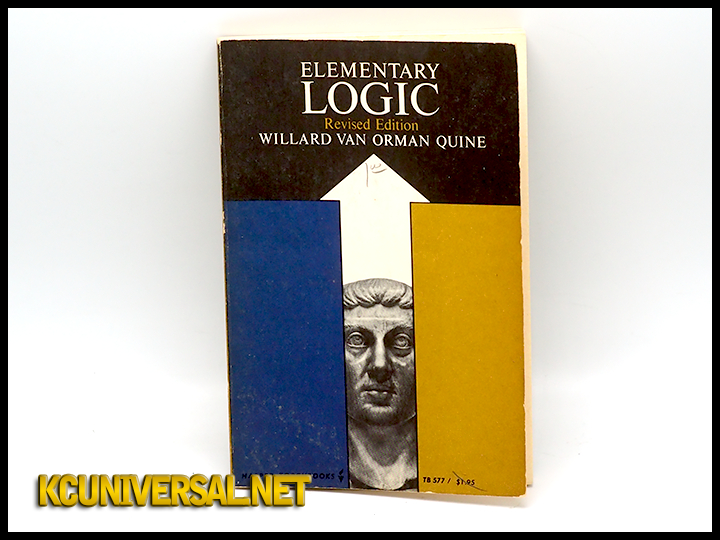
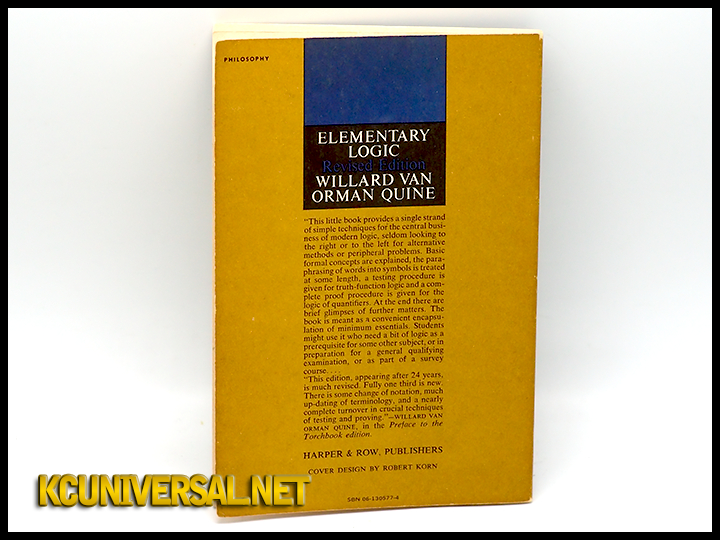
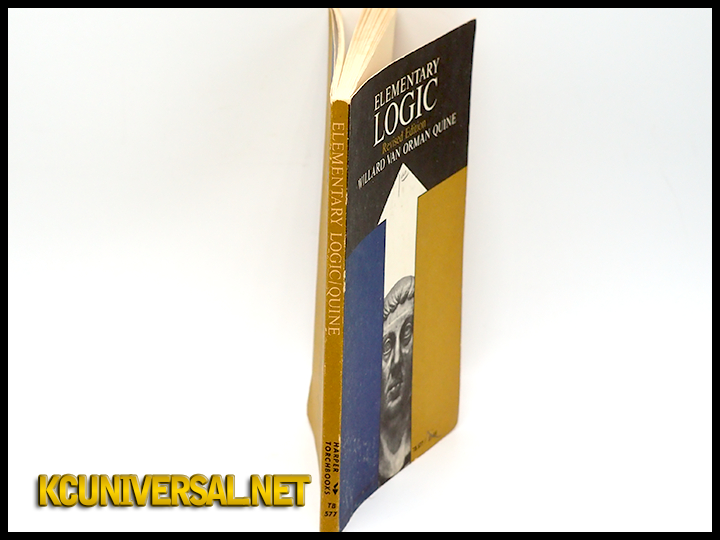
Logic is mandatory for reasoning. That's not the case many people are willing to partake in, despite shortened attention spans, lack of survival awareness, and, overall, no care about living, whatsoever. However, for the smart, strong few, wanting better clarity in today's illogical world, will find this title from Quine to be a treat. Let not the word "elementary" fool you, given this book is readily crafted for those wanting a gentle, introductory text. While it's a re-published text from 1941, there's plenty to attain for absolute beginners of the subject.
Quine was a famous philosopher during his time. His approach to logic, in this volume, was geared toward philosophy; though done in a way where those in computer science, mathematics, and literature can also appreciate. Quine introduces compound statements and their truth value(s). Readers will immediately get the feel for Quine's presentation, doing so patiently and being elaborate as possible; more-so than a Dummies book. Readers will understand what constitutes a statement, what makes them true, or false, and how it compares with other statements. Along with that are symbols that 'abbreviate' specific keywords into compact form. Mind you, given the original release of this book, readers be wary that Quine's symbolic notation used here isn't actively used today. Still, readers must approach with an open mind and familiarize themselves with how logic was presented back in its early days.
Second part of this book talks about Truth-Functional Transformations. Readers will take away methods involving pairing, substituting, and replacing "atoms," or parts of, to create new statements—conclusions—deemed truth-functional. Words like "schema" and "schemata" are presented here, becoming terms Quine uses through the entire book. In contrast, readers will learn a statement's consistency when practicing these "algebraic" manipulations of statements, and their structural techniques with respect to its propositional connectives—conjunction and disjunction, namely.
Quantification is presented on the third part of this book. This is where the material, we felt, moved fast due to its vast amount of information. What felt like a rigorous, yet slow, presentation from the first two parts suddenly picked up by this time. Readers will learn about, what we call today, the existential quantifier \(\exists\). Along with that, readers will also learn about "for all" denoted as \(\forall\); however, in this case, a negation \(\sim\) is used along with \(\exists\), representative of "everything." Due to such sudden rush of information, the reader may feel overwhelmed, if not reading this section carefully. Aside from that, Quine did all he could in clearing ambiguities associated with those quantifiers as they, themselves, may confuse the learner/student. Either way, there are lots presented and taught, recommending readers re-read certain parts if need be.
The chapter about Quantificational Inference section wraps up this book, though not the last. Readers will learn about bound and free variables, along with atomic schemata. One of the more interesting parts for us were lessons titled "Predicates." This part 'plays' like algebra by means of substitution. Added with that are more concepts extending methods of validity, substitution, and equivalence: all which were presented nicely. Closing out this book overall is a brief on membership: scratching slightly on set theory. Given its discipline is complementary to logic, it's one of the shortest chapters in this book. Ironically, Quine has written and released a book on such subject it—Set Theory and its Logic, as it's titled (though Quine made mention of his other book he wrote titled Mathematical Logic here).
After each chapter, Quine provides some exercises for readers and learners to try. There aren't very many, and some range from easy to tricky. Unfortunately, this volume does not include correct answers at the back. It's best you give them a try yourself before searching online, or a AI/chatbot, for the correct answer(s).
No book on classical logic can get any more elementary than this—so far. Because of that, those experienced in [mathematical] logic won't gain much from this, other than approaching this book like a black & white film: read and enjoyed for reverting back in history. For that, we strongly recommend this title to serious, advanced high school students; also for teachers teaching logic at an elementary level. In addition, those serious about getting started in philosophy, literature, or, perhaps, psychology and law, this book should be gentle enough. For amateur mathematicians and logicians, even professionals, unless they want to pick up Quine's presentation style, contrasting logic taught in its early days, there aren't much you're missing out. For fans of Quine will find our review as reminder in adding this to their collection. Otherwise, its slow pace is perfect for those who love the gentle style of teaching. Be mindful, as mentioned earlier, that the pace picks up mid-way through this book.
Don't let this small, short, re-published book trick you into thinking there's not much; as there's plenty to gain from this. Get your logic skills sharpened: check it out!
Support our work by donating!
- Willard Van Orman Quine.
- A logic book more elementary than the Dummies style of teaching.
- Slow-paced teaching, perfect for those inexperienced on the subject.
- Less than 200 pages.
- Presentation may be too slow for others.
- Pace picks up by the second half of this book.
- Last chapter about set theory was muddled.
PROFILE |
|
|---|---|
| Title | Elementary Logic (Revised Edition) |
| Author(s) | Willard Van Orman Quine |
| Description | -- |
| Dedication | -- |
| SBN | 06-130577-4 |
| Book Dimensions | Width: 5.31″ (5 5/16″) |
| Height: 7.94″ (7 15/16″) | |
| Depth: 0.38″ (3/8;″) | |
| Page Count | 160 |
| Cover Design | Robert Korn |
| Book Number | TB 577 |
| Contents | Preface to the Revised Edition, Preface to the 1941 Edition, 1. Introduction; I • STATEMENT COMPOSITION: 2. Truth Values, 3. Conjunction, 4. Denial, 5. 'Or', 6. 'But', 'although', 'unless', 7. 'If', 8. General and Subjunctive Conditionals, 9. 'Because', 'hence', 'that', 10. Reduction to Conjunction and Denial, 11. Grouping, 12. Verbal Cues to Grouping, 13. Paraphrasing Inward; II • TRUTH-FUNCTIONAL TRANSFORMATIONS: 14. Substitution in Truth-Functional Schemata, 15. Instances, 16. Equivalent Schemata, 17. Truth-Functional Equivalence, 18. Replacement, 19. Transformation, 20. Proofs of Equivalence, 21. Alternation and Duality, 22. Normal Schemata, 23. Validity, 24. Truth-Functional Truth, 25. Inconsistency and Truth-Functional Falsity, 26. Implication between Schemata, 27. Truth-Functional Implication; III • QUANTIFICATION: 28. 'Something', 29. Quantifiers, 30. Variables and Open Sentences, 31. Variants of 'Some', 32. 'Some' Restricted, 33. 'No', 34. 'Every', 35. Variants of 'Every', 36. Persons, 37. Times and Places, 38. Quantification in Context; IV • QUANTIFICATIONAL INFERENCE: 39. Quantificational Schemata, 40. Predicates, 41. Restraints on Introducing, 42. Substitution Extended, 43. Validity Extended, 44. Equivalence Extended, 45. Inconsistency Proofs, 46. Logical Arguments, 47. Identity and Singular Terms, 48. Membership, Index |
| Author Photograph | -- |
| Published | 1965 (originally published 1941) |
| Publisher | Harper & Row, Publishers (originally published by Ginn and Company) |
| Printed | United States of America |
| Copyright | Copyright © 1941, 1965 by Willard Van Orman Quine |
| Book Format | Trade paperback |
| Quoted Reviews |
"This little book provides a single strand of simple techniques for the central business of modern logic, seldom looking to the right or to the left for alternative methods or peripheral problems. Basic formal concepts are explained, the paraphrasing of words into symbols is treated phrasing of words into symbols is treated at some length, a testing procedure is given for truth-function logic and a complete proof procedure is given for the logic of quantifiers. At the end there are brief glimpses of further matters. The book is meant as a convenient encapsulation of minimum essentials. Students might use it who need a bit of logic as a prerequisite for some other subject, or in preparation for a general qualifying examination, or as part of a survey course. . . . "This edition, appearing after 24 years, is much revised. Fully one third is new. There is some change of notation, much up-dating of terminology, and a nearly complete turnover in crucial techniques of testing and proving." — WILLARD VAN ORMAN QUINE, in the Preface to the Torchbook edition. |
| Best Seller's List | -- |
| Other | HARPER & ROW, PUBLISHERS the text of this book is printed on 100% recycled paper This book was originally published in 1941 by Ginn and Company. It has been extensively revised by Dr. Quine for the Torchbook edition. All rights reserved. No part of this book may be used to reproduced in any manner whatsoever without written permission except in the case of brief quotations embodied in critical articles and reviews. For information address: Harper & Row, Publishers, Incorporated 10 East 53rd Street New York, N.Y. 10022 First edition: HARPER TORCHBOOKS, 1965 Harper & Row, Publishers New York, Evanston and London |

MORE BOOK REVIEWS


Comments
Add Comment
This policy contains information about your privacy. By posting, you are declaring that you understand this policy:
- Your name, rating, website address, town, country, state and comment will be publicly displayed if entered.
- Aside from the data entered into these form fields, other stored data about your comment will include:
- Your IP address (not displayed)
- The time/date of your submission (displayed)
- Your email address will not be shared. It is collected for only two reasons:
- Administrative purposes, should a need to contact you arise.
- To inform you of new comments, should you subscribe to receive notifications.
- A cookie may be set on your computer. This is used to remember your inputs. It will expire by itself.
This policy is subject to change at any time and without notice.
These terms and conditions contain rules about posting comments. By submitting a comment, you are declaring that you agree with these rules:
- Although the administrator will attempt to moderate comments, it is impossible for every comment to have been moderated at any given time.
- You acknowledge that all comments express the views and opinions of the original author and not those of the administrator.
- You agree not to post any material which is knowingly false, obscene, hateful, threatening, harassing or invasive of a person's privacy.
- The administrator has the right to edit, move or remove any comment for any reason and without notice.
Failure to comply with these rules may result in being banned from submitting further comments.
These terms and conditions are subject to change at any time and without notice.







Comments